- Available Sept. 11th.
- 1) Red Dirt
- 2) The Hard Way
- 3) Sink 'Em Low (The Holler)
- 4) The Things That Matter
- 5) Econoline
- 6) Can't Stop Dancing
- 7) Balance
- 8) Thank You For My Hands
- 9) Played Again
- 10) Should Have Been Raining
- 11) Old Time Man
- 12) Home To Me

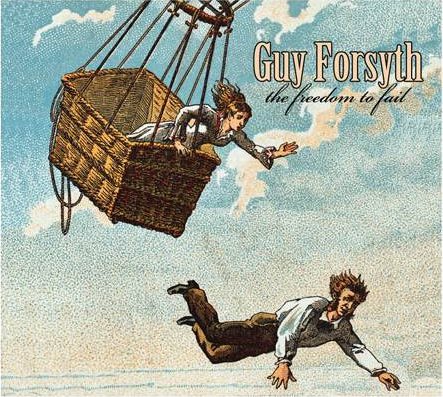
The Freedom to Fail marks an exploration into new territory for 20-year Austin veteran Guy Forsyth. Rather than focus his efforts solely on producing an album that embodied the considerable energy surrounding he and his band’s dynamic live performances, Forsyth instead opted to create a work focused on songcraft. One that reflected the power of the live show, but that also doubled as a cohesive message to his young daughter, instilling upon her – among other things – the importance of living with the freedom to fail.
“These songs represent an articulation of the changes in my viewpoints and the new legality that I see,” Forsyth explains of the album, his first on Houston-based imprint Blue Corn Music. “Becoming a father in this period of time and looking around me and trying to figure out what it is that I had to say to my daughter to explain myself. I don’t feel the need to explain myself to everyone, but I sure as hell feel the need to explain myself to my daughter, because I want her to have that sort of connection with her origins.”
Produced by Matt Smith and recorded at the Lost Oasis Studio in Austin, Texas, The Freedom to Fail finds Forsyth weilding a wide array of stringed instruments both contemporary and traditional, including the banjo, mandolin, baritone guitar, and harp guitar, a 12-stringed instrument made popular at the turn of the 20th century. Forsyth’s diverse play gets a boost from support players like Austin icon Jon Dee Graham, fellow Asylum Street Spankers alums John Doyle and multi-instrumentalist Sick, trumpeter Oliver Steck, and long-standing, much beloved and newly married rhythm section: drummer Nina Singh-Botta and bassist Jeff Botta.
“When I started to figure out what I wanted the recording to be, it became an album about the things that I really wanted to say,” Forsyth says. “They were things that I wanted to go on record as having said, songs like “The Things that Matter.” They’re very simple, and they’re certainly not unique. But that is the sentiment. I can’t be too clever about this, because the truth of it is so simple.”
Forsyth was a street-smart entertainer raised on American western standards and musical soundtracks. While growing up in Kansas City, Missouri, he cut his teeth working as a comic stuntman at renaissance faires, passing tip jars after each sideshow performance. He was a natural born showman.
Guy Forsyth arrived in Austin on January 10, 1990, with a guitar in his hand and a harmonica in his pocket, and it didn’t take him long to find his calling. He started by busking on the streets of Austin and quickly worked his way up to the local bar scene, playing shows at bars like the now famous Joe’s Generic for the tip jar – shows that have become legend amongst many long-time Austinites.
All of a sudden, Guy had built himself a band and a viable career. He found himself a fan in a Dutch record label that helped him cut his debut album High Temperature and brought him across the Atlantic to tour. When he got back, Forsyth found that he was starting to earn the attention of the bigger players in Austin’s music scene.
He began playing residencies at Antone’s, and in 1995, he cut his first record, Needlegun, for Antone’s Records, which took him back to Europe again, and when he returned he came back to busk corners with the side-project he had formed in 1994: the Asylum Street Spankers, who began playing entirely on acoustic instruments, and who’s tongue-in-cheek exploration of the Great American Songbook can still be found seeded throughout Guy’s live set. Forsyth would captain the Spankers until 1997, who enjoyed a meteoric rise on the burgeoning and crowded Austin music scene, when preparations began for his third album, Can You Live Without, his second record to be released on Antone’s. Wanting to avoid a diffusion of focus, Guy left the Spankers to pursue his solo career.
But Antone’s Records was struggling to stay afloat, and soon after Can You Live Without was released Forsyth found himself tied to the anchor of a record label that wasn’t doing much of anything. He played out his contract in 2000 with his fourth album Steak, but by then, the label was on life support and it became impossible for Guy to get records to sell at shows – a disastrous situation for a full-time musician who lives off what he makes when he plays shows.
Antone’s Records was sold to Texas Music Group, leaving Forsyth caught without cover in the no-man’s land left by an “industry standard contract.” It took a team of kind-hearted lawyers working largely pro-bono to unravel the web of indecencies and confusion spun by the Texas Music Group, who eventually responded to the litigation by declaring bankruptcy. Their extensive catalog of Texas artists, including the likes of Don Walser, Tish Hinjosa and of course Guy, was purchased at auction by New West Records. Guy’s first three albums are slated to be amongst the first re-releases from the Antone’s catalog.
The recoup may never repay Forsyth for the opportunities lost while he was signed to Texas Music Group, but it does point to a happy ending. Those albums are finally his again, and one day soon his fans will be able to buy them. “There’s a certain satisfaction in seeing the good guys win one every now and then,” he says.
Throughout, Guy and his band forged on – touring regularly through Europe and across the States. He started his own record label, Small and Nimble Records, and it wasn’t long before he had recorded and released a new studio album. Love Songs: For and Against – considered to be his best work to date – was a record that heralded the arrival of an artist that could no longer be easily pigeon-holed as a blues artist, and included his first bonafide radio hit, “Long, Long Time”.
“Most people have a second act in the music business,” he said. “Most people have stories like this. I think that music is, at its best, something that acts as a power source for us in difficult times. It’s something that we do to keep us alive and keep us going when things are really, really bad. The reason why I do this is because music has always been such an inspiration to me, a thing that has provided a level of ecstasy more than any other distraction or entertainment.”
That energy has also proved the basis for his audience’s ecstasy. Guy Forsyth is a dynamic personality on record, but like so many before him, it’s on stage where the truth comes. And the truth is that Guy lives to perform live. The thrill is in the show. You can sense it when you see him in the clubs or on the festival stage; you can hear it on 2007′s Unrepentant Schizophrenic Americana, his double disc live compilation, and on Calico Girl, his Small and Nimble re-recording of the then-bottled up Can You Live Without songs; you can see it on 300 Miles from Here to There, the live concert CD/DVD he released in early 2011.
The records are the hook – the live shows are what get you into the boat, cleaned up and plopped onto the frying pan.
“I’m a ham,” he said. “I just love performing. In many ways, I’m more comfortable on stage than I am off it, and I think that comes from being exposed to good performers. I saw John Hammond play when I was 18. He was so passionate and gave himself over so completely to his performance. It wasn’t like he was indicating anything or representing what the blues should be. He got out of the way and let the song run. It was so immediate, and it was so close to life or death.”
It’s with that sense of immediacy that Forsyth releases The Freedom to Fail, his seventh album and first written after the birth of his daughter, Mary Mae.
“This record is different from the last couple projects that I worked on because I specifically set out to make a studio record, not an immediate representation of something that I was already doing live,” Forsyth said. The album represents an articulation of the change in perspective that Forsyth’s had since starting his own family.
“There’s a level of care that can go into something that speaks to a love and an interest and engagement in life. You try to make something that reflects the world as you want it to be. I just want to make songs that are worth people’s time to listen to. I’d hate it if I were wasting anybody’s time, because time is the most precious thing we have. If somebody’s going to give you their attention, you need to make it worth their while.”
Mine your craft such that it’s worthy of a stranger’s time. It’s a lesson he learned at the fairs in Kansas City, Missouri. It’s a lesson he refined on the stages of Austin, Texas. With The Freedom to Fail, it’s a lesson he’s taking to the world.